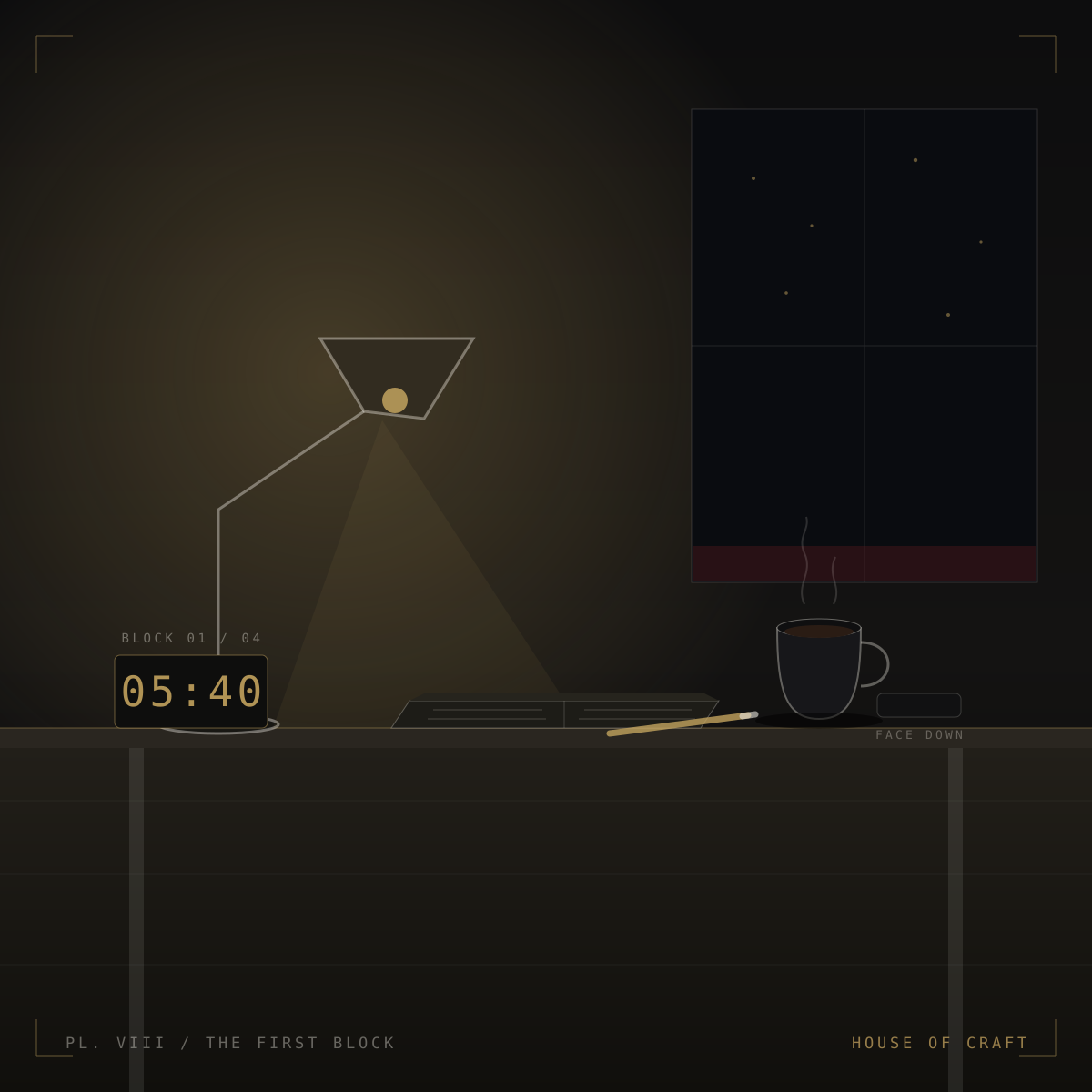
 Pl. VIII The first block
Ask a hundred ambitious people whether they want to do deep, uninterrupted, difficult work and a hundred of them will say yes. Watch those same hundred people at 06:20 on a Tuesday and you will find perhaps four of them doing it. The gap is not motivation and it is not discipline in the way that word is usually thrown around. It is that nobody warned them what the first forty minutes feel like.
They feel like nothing. That is the entire problem.
The unsellable ingredient
An enormous industry exists to sell you the accessories of concentration. Apps that block other apps. Notebooks with dotted grids. Timers shaped like tomatoes. Noise-cancelling headphones that cost more than a decent suit. All of it is downstream of a single fact that cannot be packaged, licensed or subscribed to:
Deep work is mostly the willingness to be bored for forty minutes before it gets good.
Nobody can sell you that. There is no product in it. So the market has quietly agreed to sell you everything adjacent to it instead, and you have quietly agreed to buy those things and feel productive, and everybody goes home satisfied except your actual work, which has not moved in nine months.
What the block actually is
In the House of Craft the requirement is deliberately narrow: one block, four hours, before the world is awake, on the single thing that matters most. Not on email. Not on "planning". Not on the version of your work that involves talking about your work.
The rules are short enough to memorise, which is the point.
- It starts before anyone can reach you. The specific hour matters less than the property: nobody expects anything of you yet.
- The phone is in another room. Not face down on the desk. Not on silent. In another room, on a different floor if you have one. Proximity is the variable, not notification settings.
- One artefact, decided the night before. You do not open the laptop and ask yourself what to do. That question, asked at 05:40, is answered by your email inbox every single time.
- No music with words in it. Language is the resource you are trying to spend. Do not spend it on a chorus.
- When it stalls, you stay. This is the rule that does all the work and the one everyone breaks. Stalling is not a signal to stop. It is the sensation of the shallow layer running out.
The shape of a real block
It is worth knowing the terrain, because the middle of it feels like failure to anyone who has not been told otherwise.
Minutes 0–15. Fluent and slightly false. You are writing down what you already knew yesterday. It feels like progress. It is transcription.
Minutes 15–45. The trough. You run out of the pre-formed thoughts and the work goes genuinely difficult. This is where almost everyone reaches for the phone, and this is precisely where the value is. Every real idea any of us has had arrived somewhere in this window, usually while we were considering giving up.
Minutes 45–150. The part people mean when they talk about flow. It is unremarkable from the inside. You will not notice it happening. You will notice, afterwards, that two hours went missing and something exists that did not exist before.
Minutes 150–240. Diminishing but not worthless. Editing, structuring, finishing. Most people's best work happens in the third hour and most people have never been in the third hour.
Four hours, not twelve
Members are often disappointed by how short the requirement is. They arrive believing in the sixteen-hour day, usually because someone with a ring light told them about it.
The sixteen-hour day is, with rare exceptions, a lie of accounting. It includes the two hours of looking at a screen with your mouth open, the ninety minutes of a meeting you contributed one sentence to, the reorganising of the folder structure, the third coffee, the inbox at 22:00 that generates work for tomorrow rather than finishing any today. Strip those out and even genuinely formidable people are producing three to five hours of real output. The difference between them and everyone else is not volume. It is that theirs are consecutive and defended.
Twelve hours of theatre will always lose to four hours of work, and it will lose while looking busier.
The remaining hours of your day are not wasted. They are for correspondence, coordination, training, eating properly and the ordinary maintenance of a life. Article IV of the Standard exists to protect the block precisely so the rest of the day can be spent generously. A person who has already done their real work by eleven is extraordinarily pleasant to be around. A person still chasing it at nine in the evening is not, and their family knows it.
Defending it
The block will be attacked, and rarely by strangers. It will be attacked by good clients with reasonable requests, by colleagues in different time zones, by your own low-grade anxiety that something is happening without you. Every single defence comes down to one unglamorous sentence, delivered without apology or elaboration:
"I'm not available before eleven. I can do two o'clock."
That is the whole technique. The second sentence, the explanation and the justification and the little laugh, is where people lose the block, because it invites negotiation. Say the first sentence. Stop talking. In our experience roughly nobody has ever pushed back, which tells you how much of the pressure was self-generated in the first place.
The uncomfortable part
Four consecutive hours will tell you, unambiguously and within about a fortnight, whether you are actually good at the thing you have told people you do.
Most avoidance of deep work is not laziness. It is a well-organised strategy for never finding that out. The meetings, the tools, the optimisation of the system, the reading about the work, all of it is a way of remaining a person who could be excellent rather than one who has checked.
Check. It is worse than you fear for about six weeks and then it is considerably better than you hoped, and either way you will finally be dealing with something real. Everything in this academy is downstream of that one decision, including, eventually, the vineyard.