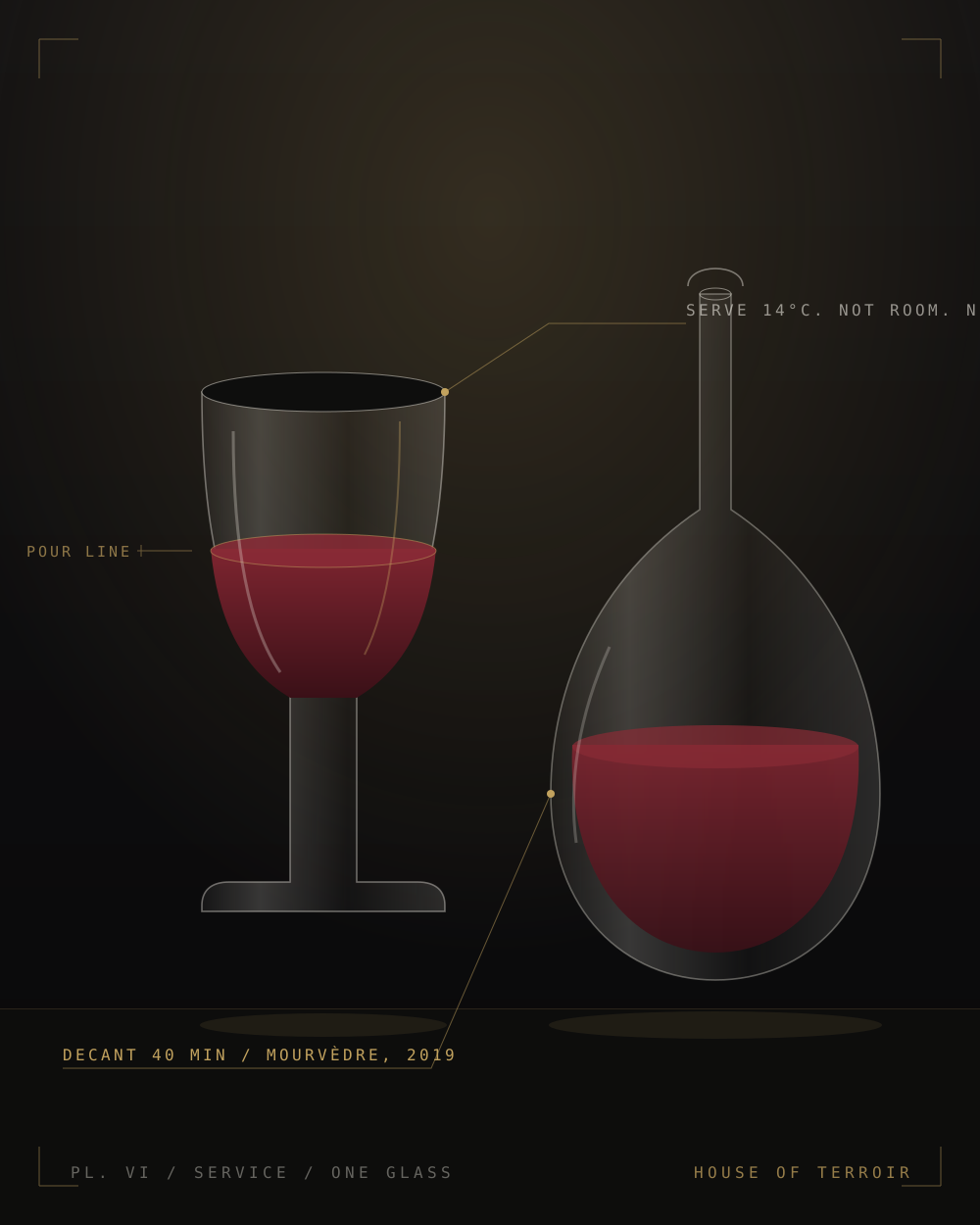
 Pl. VI Service, one glass
In November the vines at Clos du Signal look dead, the tourists have gone, and the mistral comes down the valley hard enough to make the shutters complain all night. It is the best month here, and it is when we teach people to taste, because in November there is nothing pretty to hide behind.
Almost every member arrives with the same two anxieties, which are opposites and are held simultaneously: that they know nothing about wine, and that learning about wine will turn them into the sort of person they cannot stand.
Both are solvable. The second is the one worth taking seriously.
The insufferability problem
Wine attracts a specific failure mode. A man learns eleven facts, acquires a vocabulary, and immediately begins deploying it at dinner tables where nobody asked. He describes. He corrects. He sends things back. He has confused knowing about wine with having taste, which are close to unrelated.
Taste is what you notice. Expertise is what you can name. They are not the same skill and only one of them improves an evening.
The House of Terroir is unusually strict about this. The assessment is a blind flight of six and you are not scored on being right. You are scored on being specific. "Sour" is a better answer than "a hint of forest floor" if sour is what you actually noticed. Members who arrive able to perform the vocabulary tend to do worse than members who arrive with nothing, because they have to unlearn the performance first.
Three rules, and that is genuinely all
I / Structure before flavour
Beginners chase flavour: cherry, leather, tobacco, the whole descriptive parlour game. Flavour is the least useful part and the hardest to agree on. Structure is easy, teachable and tells you nearly everything:
- Acid. Does your mouth water? Where, and for how long?
- Tannin. Does it dry the gums, and is that drying smooth or gritty?
- Body. Thin, or does it coat?
- Length. Count the seconds after you swallow. Genuinely count them. This single habit will teach you more in six months than any book.
Four questions, asked every time, in the same order, for a year. That is the entire curriculum. Everything else is decoration.
II / Live in the £14 to £30 window
Below about fourteen pounds a bottle in the UK, tax and glass and shipping eat almost all of it and you are drinking process rather than place. Somewhere around fourteen the money starts reaching the actual wine, and it keeps improving sharply until roughly thirty. Above that, improvement continues but the curve flattens hard and scarcity starts doing most of the pricing.
Buy in that window, relentlessly, for eighteen months. Buy the same grape from four different places. Buy the same place across three vintages. You will learn more from twelve bottles bought deliberately at £22 than from one bought reverently at £300, and you will not have spent an alarming amount of money finding out.
III / Fix the temperature and half of it is solved
The single largest improvement available to most people costs nothing. Red wine should be served at about 14°C. Not at "room temperature", a phrase that fossilised in an era of stone houses and no central heating, and which now means twenty-two degrees and a wine that tastes of alcohol and disappointment.
Twenty minutes in the fridge before serving. That is it. Whites, conversely, are almost always served too cold, which flattens them into nothing, so take them out of the fridge fifteen minutes before you pour.
Why Bandol, and why here
We plant Mourvèdre on the north face because it is a difficult, late-ripening, unfashionable grape that needs more sun than it has any right to ask for and rewards patience specifically. It is the backbone of Bandol, an hour and a half south of us on the coast, and it makes wines that are frankly unpleasant when young and remarkable at twelve years.
This is not a coincidence of curriculum. It is the House of Terroir's entire argument, made in a bottle: the thing that is difficult, slow and unimpressive early is very often the thing worth owning. Members who understand that about Mourvèdre tend to understand it about businesses, training programmes and people shortly afterwards.
Nothing at this estate is a metaphor by accident.
At the November assemblage, members taste the component parcels separately, thin and angular and individually unconvincing, and then taste the blend. Nobody has ever needed the lesson explained afterwards.
What "half a glass" means
The Standard permits wine, plainly, and members occasionally read Article VII as puritanical. It is not. The rule is half a glass, tasted, not because drinking is a vice to be rationed, but because the second glass is where attention goes and the fourth is where tomorrow goes.
A person who drinks one glass properly, notices it, talks about it for ninety seconds and then talks about something else has extracted approximately all the available pleasure. A person who drinks the bottle has extracted rather less of it and has traded a morning for the privilege. We are not against the bottle. We are against paying for it twice.
Party hard, by all means. Host better. Then be the one still standing at 23:30, clearing plates, entirely capable of the hill at 06:15.